
EFT Supervision and Consultation

Hi there! My name is Lauren Eisleben and I am a therapist in mid-Missouri; I practice at Individual, Marriage & Family Counseling where I provide individual, family, couples, and group therapy services.
In addition to working with clients, I am privileged to provide clinical supervision to counselors-in-training and PLPCs in the State of Missouri and Emotionally Focused Supervision to my colleagues in the mental health field. I hold ICEEFT certifications in couple’s therapy and family therapy, and am a certified Supervisor in both. You can read more about my supervision style at the end of this post.
What am I currently offering for EFT clinicians?
- Individual and group supervision for those working toward EFCT or EFFT certification
- EFFT Consultation/Supervision Group — Virtual consultation group for those practicing Emotionally Focused Family Therapy or those who would like to learn more about the modality. No prior EFT experience or training necessary to participate.
- Advanced Consultation/Supervision Group – Participants must have completed at least EFT Externship and be willing to share recorded audio/video clips of them working with clients. Sample ICEEFT consent will be shared if requested.
- Beginning EFT Skills group – Participants need not have completed any formal EFT training to attend. No recordings required for this group.
Why a supervision/consult group?
Every single EFT training I have attended – virtual, in-person, a few hours, a few days – has been invaluable to me as a therapist, and more importantly, as a human. To learn how to recognize my own blocks to safe and secure attachment is a gift given to me through every trainer, author, supervisor, and colleague. As I continue to grow and learn, I find the most benefit in my development through consultation with other clinicians. While Externship and Core Skills adequately address the technicalities and interventions of EFT, myself and my supervisees often find ourselves asking these questions:
- Where am I in the EFT steps and stages?
- How do I know which partner to start and stay with?
- I keep getting blocked by cognition when I try and go emotional. At least I think I do?
- This work feels really hard and draining for me. Am I cut out for it?
- Everyone keeps talking about attachment, and I just don’t know what that really means.
- I want to do EFT work, but I’m not sure where to begin. Is one of your groups a good fit?
Do I have it all figured out?
No way! Hence, continued supervision for me, as well! I have two EFT supervisors who I meet with as-needed to discuss my own cases and my supervision questions. I also share about my own work with my supervisees and consultation group members. We’re all in this together.
What’s the format for your groups and individual consultation?
Most of my meetings with folks are on a bi-weekly basis, and I am also available for a one-time consultation session as it fits your schedule. I work mostly online as my supervisees are often not located near me, however, I am happy to meet in person with you if you’re in mid-Missouri.
The details:
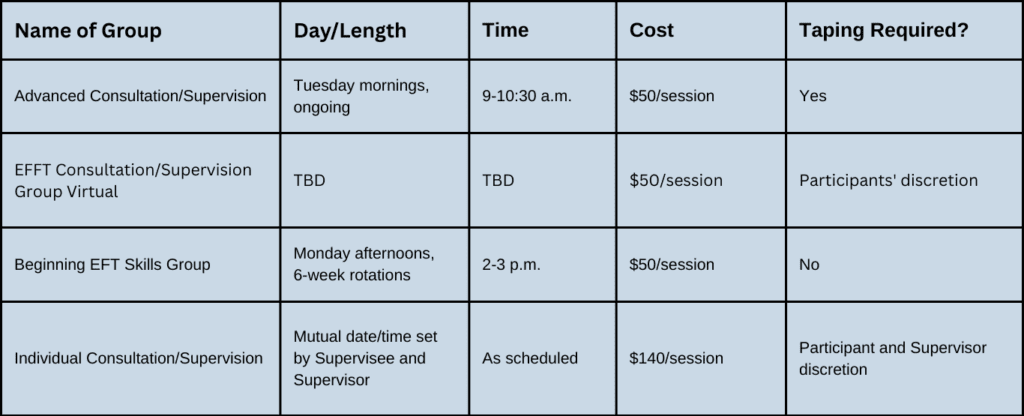
Do any hours spent in this group count toward ICEEFT certification?
Participants may apply 1-2 hours of group supervision toward the total supervision requirements. More details will be provided as needed.
What if I haven’t completed Externship or Core Skills yet?
I offer accessibility and affordability in all my services, as I believe EFT training and consultation is invaluable as a clinician and as a person! There are options for you regardless of where you are in your EFT development.
How do I sign up for supervision or consultation? Fill out the Contact Us form at the bottom of this page. You may also email me at [email protected]. See you soon!
For those interested in reading more about my Style of Supervision, here you go 🙂
Most of the clinicians I supervise come to session wanting to know where they and their clients are on the EFT road map, what stage they are in, where to go next. I often utilize the C (conceptualization) to start our sessions as a way to build tolerance and strengthen the alliance between them and me, the same way I use validating the protective action my clients take in their own cycle. As I am able to notice and experience my supervisee doing the Tango with their clients in a recorded session, I am continually looking for the emotional handle to grab in the cycle playing out between the two of us in supervision. As we move through the Tango together, I often ask permission to do a role play in the place of, or in addition to, doing an enactment with my supervisee. I then process the role play, organize it, and begin again. I find this style allows me to learn alongside them, opening new windows of insight for myself to take into my own client sessions, as well as guiding my supervisee to their next move. When all parties are given permission to be ourselves, we learn and develop new ways of being with each other without the need to be protective of our vulnerabilities.
In the therapy room in general, I tend to be more self-disclosing than some of my colleagues, and believe me, I’ve welcomed and received much supervision in this area. In the same way, I do not shy away from being self-disclosing with my supervisees in appropriate ways to benefit our time together. This stylistic choice is in line with the way I am with my clients working in EFT – being explicit about what we’re doing, how we’re doing it, and where we’re going. If I am unsure of a moment in supervision, I’ll ask my supervisee if they, too, feel some uncertainty, and can we explore that together? As a natural-born Pursuer, laying down my own agenda for how the session “should be,” has been a continual learning process for me. More so, leaning into my own intuition, not quite sure of where it will lead, is becoming more comfortable for me as time progresses. This is what I ask my clients to do in couple’s sessions; this is how I am encouraged to be with my supervisors; it only makes sense to ask my supervisees to do the same thing and be with them in their experience. It is empowering and humbling at the same time.